


An aerial shot of some of the domes containing telescopes at The Observatory Science Centre
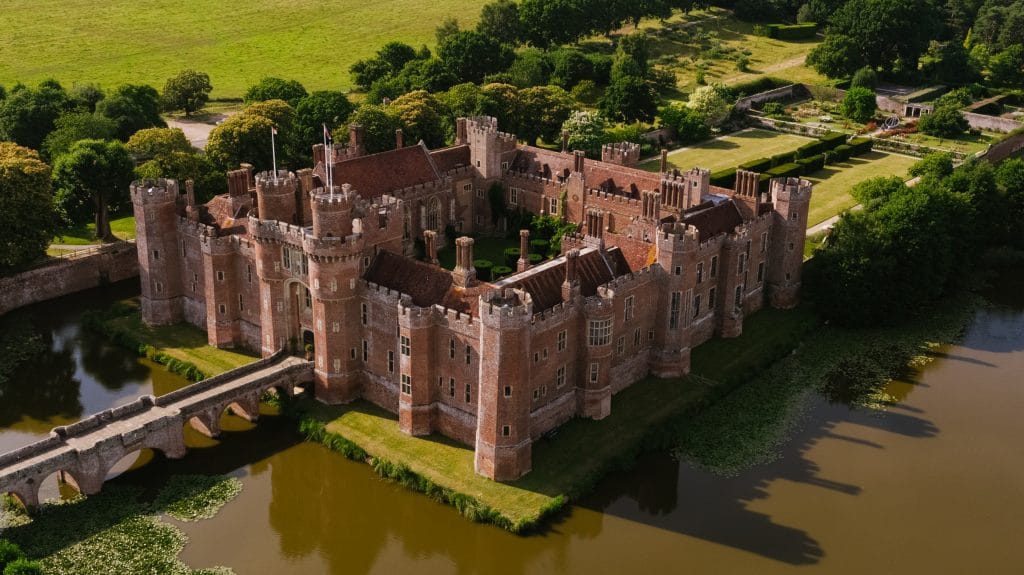
This Sussex village is most famous for its castle and grounds which sit on a 600 acre estate containing woodland, formal themed gardens and a moated castle built in the 15th Century. The castle is one of the earliest red brick buildings in England. What is less knows about this famous landmark, however, is that in 1540 it was visited by Anne of Cleves, the fourth wife of King Henry VIII. The castle is also proclaimed to possess a phantom drummer. Some say he is the ghost of a drummer killed during the Battle of Agincourt in 1415, however others believe there is no ghost, just a smuggler from the 1700s pretending to be one in order to scare away the local villagers. Before the castle was built, the village was known as Gardner Street but, in the 12th Century, a Saxon lady married a nobleman in the castle and the combination of their last names ‘Herst’ and ‘Monceux’ gave the castle, and then the village, its current name.
Herstmonceux is famous for being home to the Isaac Newton Telescope. It was established in the village in 1967 but after many years it was moved to La Palma in the Canary Islands
Herstmonceux’s church predates its castle by more than a hundred years. Its oldest parts were built in the 12th Century.
In Gardner Street you can still find the ‘Praise the Lord’ cottage, so named for the creeper growing up the front of it which had been very skilfully trimmed to read ‘Praise The Lord’. Unfortunately the words are no longer visible as the cottage was sold in 1957 and the new owner, Big Jim, decided to tear down the creeper. When she found out about this travesty, the granddaughter of the original owners enacted the ‘Curse of the Cotoneaster’ upon Big Jim.
Other local attractions are the East Sussex Falconry Centre, The Windmill, The Science Observatory and the Cold Fusion Glass Arts and Gifts at the Malthouse where you can try your hand at making your very own glass gifts.