
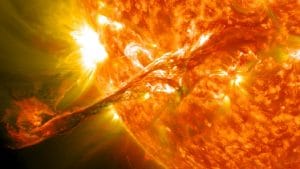
Eruption on the Sun August 31, 2012 (Image courtesy of Solar Dynamics Observatory)
The summer skies over Northern Europe never truly become dark, even at midnight twilight will be hugging the northern horizon hiding the stars. Among the twilight you might make out a pale band of light that slowly rises as the night progress. That pale band of stars is the Milky Way, our home galaxy, and in that pale band are some 200 thousand million stars. Among those billions of stars there is one lying halfway out along the spiral arms that is utterly unremarkable. Small and undistinguished in almost every aspect it would be completely overlooked were it not for one simple fact; it is our sun. So while the sun is hiding our night skies let’s turn our attention to the sun.
Over the course of a year the sun appears to move from south to north and back again and this month it halts its northern progress and starts back south again. We have reached the summer solstice, longest day and shortest night of the year. While it hides the night sky from us it is a chance to consider our nearest star. The numbers are typical of those in astronomy; it is 5 billion years old, weighs in at 2 octillion tonnes, burns 700 million tonnes of fuel every second fuel at 15 million centigrade in its heart and yet, despite the scale of those numbers, it is a small star. Almost every star you see in the night sky is vastly hotter, larger and more impressive than our sun.
Of course without some very specialist equipment observing the sun is not just difficult, but actually dangerous. Solar astronomy has some very specialist and frankly downright strange equipment to study the sun. Equipment that can look into the heart of the sun, listen to the way it rings, watch the surface boiling in a maelstrom of extreme physics and map storms blasting out across the solar system.
Storms across the solar system? Yes, bizarre as it might seem there is such a thing as space weather. Our sun, apparently calm and placid, can send vast eruptions of material into space and heading towards the Earth in an outburst that can disrupt technology on Earth. Way back in 1859 there was

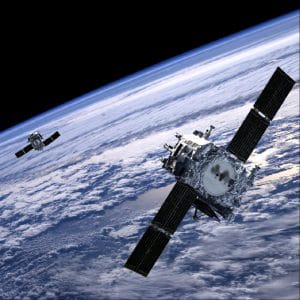
The Stereo solar observatories preparing for deployment – Image courtesy NASA/JHU
an eruption known as the Carrington event. Astronomers in Europe could see bright eruptions on the Sun and 12 hours later the eruptions hit the Earth, causing the Northern lights to be seen as far south as Colombia and telegraph operators to be able to run their equipment with no power, albeit at the expense of electric shocks and the occasional fire!
Modern technology is even more vulnerable. In 1989 solar storms knocked out the electricity across a large part of Canada. Solar storms now can knock out aircraft communication, GPS navigation and satellite communication So we now have a whole suite of spacecraft watching the sun and giving weather forecasts. A thousand years ago we would watch the sun to as our only source of light navigate now we watch the sun to keep the lights on and still to allow us to navigate.
This article was written by Jarvis Brand of The Observatory Science Centre in Herstmonceux