Charles Burgess Fry was born in 1872 in Croydon and is my interesting life with a local link this week (Article by local historian and writer Nicola Walker)

Charles – known as CB Fry – was a sporting legend.
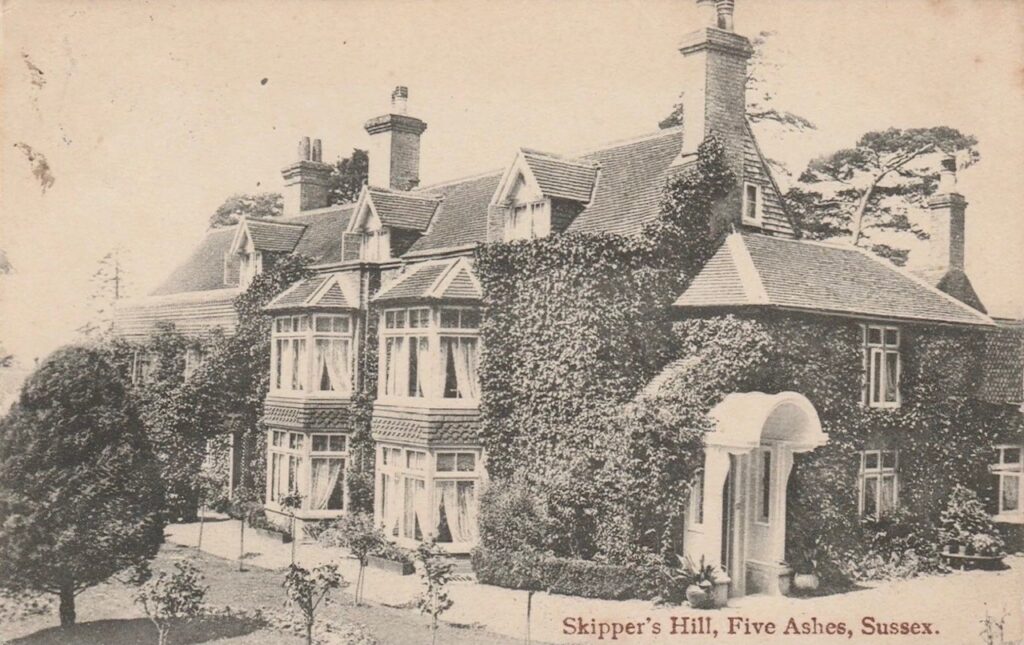
Charles spent much of his childhood at Skippers Hill Manor in Five Ashes and is said to have been inspired by its unique location set above the stunning woodlands of the Sussex Weald.
It seemed that CB had it all. He won a scholarship to Oxford and gained a Degree in the Classics, he was athletic, handsome and an outstanding all round sportsman.
Fry’s party trick was to leap from a stationary position backwards onto a mantelpiece, he would face the mantelpiece, crouch down, take a leap upwards, turn in the air and finish up on the shelf – to the amusement of dinner party guests that he had been persuaded to perform for.
In 1893, the year he gained his degree, he set a British long jump record (7.14m) and later equalled the World Record (7.17 m) boasting that he set the World Record following a heavy lunch and half a cigar, which he returned to finish after. He had carried out very little training and received almost no expert advice in the field.
Although gifted on the sports field and academically, CB had a history of mental illness and had several breakdowns, the first being during the last term of his university degree and is probably what prevented him from gaining the first he had been predicted to receive.
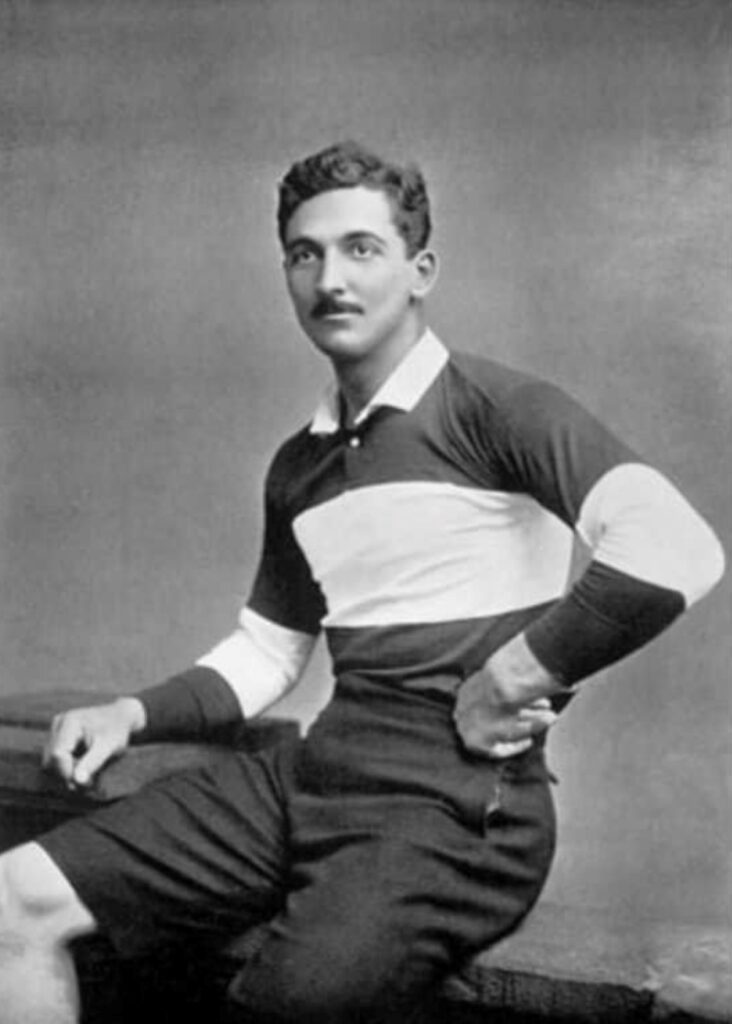
CB played rugby for the Barbarians (photo below in 1893), played football for England in 1901 and in the FA Cup final in 1902 for Southampton.

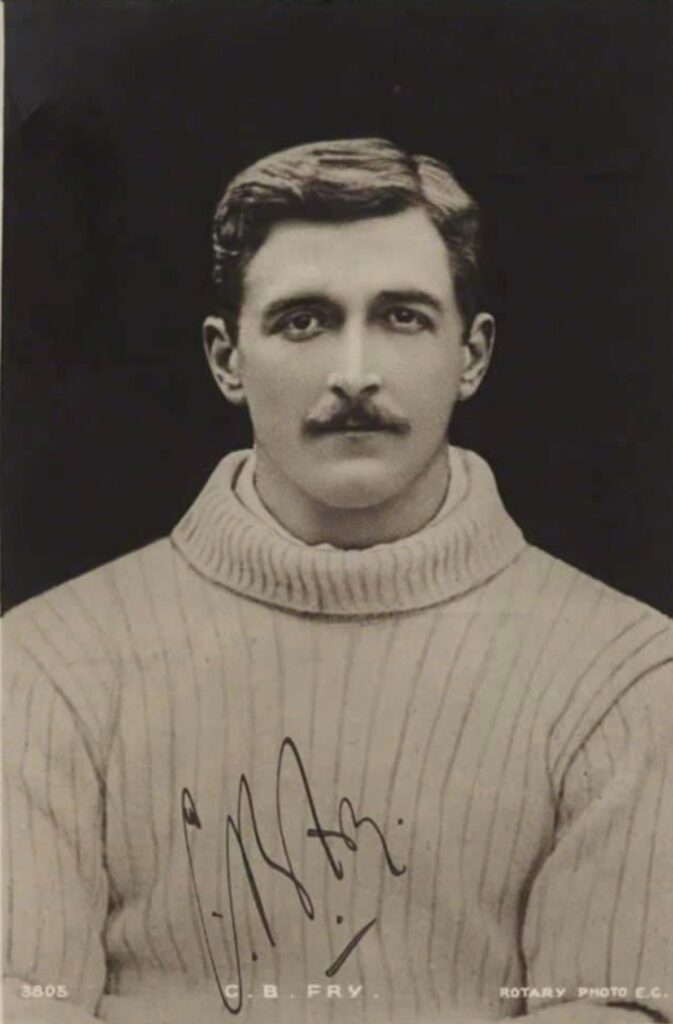
His greatest achievements, however, were at cricket. Between 1894-1908 he played cricket for Sussex and was called up to play for England in 1899 for the last match WG Grace appeared in at Trent Bridge. He became England Cricket Captain in 1912. Between 1909 – 1921 he played for Hampshire, retiring in 1922 having totalled 30,000 runs and 94 centuries during his career.
In 1898, he married celebrated beauty Beatrice Sumner, a woman 10 years his senior and described as ‘fiery, strong-willed and aggressive’. She was the mistress of wealthy banker Charles Hoare by whom she had two children. It is uncertain whether she ever gave up her romantic tie to Charles during her marriage to CB (although they had 3 children together) and it is likely Charles provided finance to the couple, as CB’s sporting career earned little money. CB and Beatrice went on to run a Navy training ship – The Mercury – founded by Beatrice, where she was remembered for her extreme cruelty and violence to the students.
CB’s regular income came from sporting journalism and between 1904 – 1914, he edited and directed ‘Fry’s Magazine of Sports and Outdoor Life’, a magazine that covered a wide range of subjects all written by CB.
In 1920, he accompanied his old friend from his Sussex cricket days, the cricketer Prince Ranjitsinhji in an Indian delegation to Geneva at the League of Nations.
He stood unsuccessfully as a Liberal candidate in 1922 (Brighton), 1923 (Banbury) and 1924 (Oxford). Around this time he had started to have psychotic episodes and began to dress unconventionally – on one occasion stripping naked whilst on a walk along the Brighton seafront.
CB was an admirer of Hitler and met him in the mid 1930s, hoping to promote cricket to the Nazis and forge closer links between the Boys Scouts and the Hitler Youth.
After the war, CB took up cricket commentary on the radio and in 1955 he appeared on Eamonn Andrew’s ‘This is your life’ programme.
Beatrice died in 1946 and their son later said that his Mother had ‘ruined his Father’s life’. She had certainly had an impact on CB’s mental health, as his daughter-in-law later commented: “I should think anyone would have a breakdown, married to her”.
CB died aged 84 in 1956 and lies in Repton Parish Churchyard, Derbyshire.
To the end of his life he enjoyed dancing and regularly wrote poetry in Latin and Greek.