
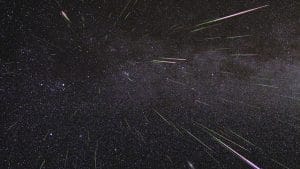
Meteor shower – image courtesy of NASA
Throughout July the sky never grows truly dark as even at midnight the sun is still clinging only a short way below the northern horizon. Fortunately this never really gets in the way of studying the really bright objects such as Mars and Jupiter, both of which were in the news recently; Jupiter with the announcement of 10 more moons being found bringing its tally to 79 moons and perhaps, more significantly, Mars was in the news with the European Space Agency announcing the discovery of liquid water under the ice surfaces of its poles.
With August astronomical twilight and truly dark skies return, particularly after midnight when some towns turn off a lot of unnecessary lighting. Something that benefits from darker skies and being past midnight are meteors. The flash of a meteor across the sky is the last gasp of a fragment of the early solar system. Beyond the planets in the frozen regions of the Kuiper belt and Oort clouds are icy remnants of the early solar system. A slight gravity tug from the planets or a nearby star or a collision sends remains tumbling in toward the Sun. As they approach they heat up and turn into comets and then fade away into a trail of debris circling the sun. As the Earth crosses its path the tiniest of fragments plunge into the atmosphere at 100,000 kms an hour and burn up in the upper atmosphere.

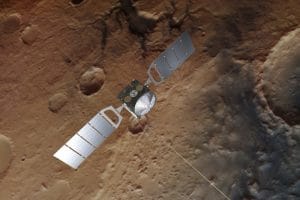
ESA’s Mars Express above the surface of Mars – Image courtesy of ESA
One of those was the comet Swift Tuttle and every August the Earth crosses its path. As we do so we pass through the trail of debris and the number of meteors rises dramatically. After midnight our skies are facing towards the Earth’s movement and meteors will appear faster and brighter. These are the Perseid meteors – so called because they appear to come from the constellation of Perseus. On the nights of 11th to 13th August the constellation of Perseus lies low on the North East horizon and a larger than average number of meteors will be seen all appearing to come from Perseus.
On any night you might expect to see about five meteors an hour. On these nights you can expect to see 60 or more an hour and in 1992 there were about 500 meteors an hour. The vast majority of meteors are tiny objects; a gramme or less and far too insubstantial to reach the ground. On occasion, large ones can make it to the ground. Notable examples being recently in Chelyabinsk in Russia, some 50,000 years ago in Arizona which left a kilometre wide crater and, perhaps the most well known example, some 65 million years ago when the dinosaurs were finally pushed to extinction. Fortunately such examples are ludicrously rare and meteors are a free spectacle that anyone with a clear sky and no lights can enjoy.
Jarvis Brand runs the planetarium for the Observatory Science Centre and can be contacted on planetarium@the-observatory.org or on 01323 832 731.
The Observatory Science Centre will, in addition to being open every day throughout August, be open on the evening of the 10th and 11th when the Perseid meteor shower will reach its maximum, and in the evenings of 31st August – 1st September for our annual astronomy festival.