
What’s up above at the moment?
28th June
Jupiter still dominates the early evening skies but this month Mars reaches its highest point for the year and its closest and brightest point for many years. Mars is at opposition and only 57 million kilometres distant. Even a small telescope will show a distinct sphere and a reasonable telescope will be able to see some surface features. Though that may be difficult this month as Mars is currently swathed in a planet wide dust storm. The real difficulty for those of
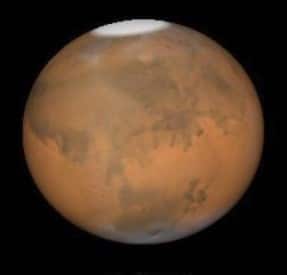
Mars at opposition. The ice poles and some surface features are clearly visible
us in the northern hemisphere is that because of the way the planets orbits align whenever Mars is at its closest it will be at its lowest in the sky. If you are in the south of Europe it is not too bad, but from the North it is very low above the horizon.
Far easier to see for anyone is the Moon even if it is far smaller than many people imagine. Most people vastly overestimate the size of the moon because it dominates the night sky when visible. (Try measuring it sometime against an outstretched hand!) On the 27th the Moon is full. Just like Mars at opposition the moon is full because it is on the opposite side of the Earth to the Sun and, just like Mars’ orbit is not perfectly aligned, the Moon’s orbit is not perfectly aligned and the Moon is rarely exactly opposite the Sun. However this month it is and on the 27th the Moon will not just rise as a full moon but will rise in eclipse. The Moon will pass exactly into the shadow of the Earth.
Apart from being a neat alignment it has a couple of cool effects. The shadow is not completely dark but sunlight filters through the Earth’s atmosphere and in just the same way that the evening sun will redden, the light across the moon will redden. A second cool effect is that the shadow can be seen to have a distinct curve from the curve of the Earth. It’s one of the easiest ways to demonstrate that the Earth is round and is a convincing demonstration that the way that the Earth being round has been known for thousands of years. With a little care it is even possible to measure the curve by eye and so measure the size and distance of the Moon.
The eclipsed Moon is sometimes referred to as a blood moon because of the obvious red shadow. In another wonderful coincidence Mars is named the red planet because of its obvious colour and it is that colour which lead to it being named for the Roman god of War. In one last lovely coincidence we now know that the red colour of Mars comes from the dust o
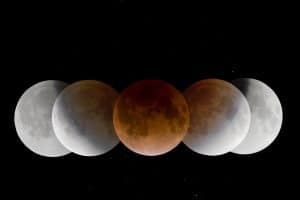
The eclipsed moon under the curved shadow of the Earth
n its surface. The same dust that currently obscures our view of the surface of Mars contains a large amount of iron and when iron and oxygen mix the compound has a distinctive red colour and the blood that it in your veins takes its red colour from exactly the same process.
Jarvis Brand runs the planetarium for the Observatory Science Centre at Herstmonceux and can be contacted on planetarium@the-observatory.org, 01323 832731.
The Observatory Science Centre will, in addition to being open every day throughout July, be open on the evening of the 27th when Mars will be at opposition and the Moon in eclipse.
